

The maths that changed how I think about wellness...
4 minute read
Skip to:
- Why was I taking eight supplements?
- What happened when I took the right supplements?
- The question we kept asking
- What does it actually cost to build your own supplement stack?

For a period of my life, my bathroom shelf looked like a small pharmacy.
Eight different supplements. Eight different bottles, eight different doses, eight different things to remember. And a bill that added up to close to £400 a month — money I was spending partly out of hope, and partly because a very good nutritional therapist I trusted had told me I needed all of them.
She wasn't wrong. Each product served a purpose. The problem was the economics of the thing, and what it meant for women who weren't lucky enough to have the same access.
Let me explain how I got there, and what happened next.
Why was I taking eight supplements?
I had come off the contraceptive pill after nearly a decade, and my skin had reacted immediately and dramatically. Cystic acne across my chin, my forehead, between my eyebrows. I was working in equity sales at the time, in a male-dominated environment where I already felt I had to work twice as hard to be taken seriously. My skin made everything harder.
I had tried everything available through conventional medicine. The pill had worked, which is why I had been on it so long. Off it, I was told my options were hormonal medication or Roaccutane — which was off the table because my husband and I planned to try for a baby in the not-too-distant future.
Alice and I had been friends since university. She had gone in a completely different direction — two science degrees, then her own clinic. She sat me down and explained something that changed how I understood my own body. The skin can be a barometer for what is happening internally. My skin wasn't a skin problem. It was a systemic problem — a combination of hormonal imbalance, possible gut issues and nutritional deficiencies, all of which could be contributing to inflammation in my skin, expressing itself on the surface.
She put me on a protocol. Eight different practitioner-grade products, covering a broad spectrum of nutrients. Available only through clinical channels, and the cost was significant. I can remember blanching at it, especially since I had already invested in creams, and had experimented with harsher skin treatments. I was desperate, so I decided to give it a go for a month and see what happened.
What happened when I took the right supplements?
Amazingly, it paid off — and then some. Within six weeks, my skin was the clearest it had been in almost a decade. And it wasn't just my skin — my energy, my mood, my digestion, my sleep all felt different. Something had shifted in a way that nothing else had managed.
I also realised I had been extraordinarily lucky. I had a university friend who happened to have the exact expertise I needed. I had access to private clinical care, and I was in the fortunate position of being able to take a gamble with the cash to see what happened. But sitting there, I kept thinking about how many women were in the same position I had been in — and had none of those things. Because the numbers are striking. An estimated 60% of the UK population will experience a skin condition at some point in their lives, and women are consistently more affected than men across almost every category. Skin conditions are among the top reasons for GP consultations in the UK, and women are also 20% more likely than men to suffer.¹ And yet the standard response is almost always topical — a cream or possibly a prescription, sometimes for antibiotics, the pill or something stronger. Acne alone commonly persists into women's 20s, 30s, and 40s¹ — long after it is supposed to have resolved — and in many cases it is never properly investigated for the internal drivers that are almost always there. That felt wrong to me then, and it still does.
The question we kept asking
Alice and I started asking whether there was a way to make what she had created for me accessible to more women — she was already using these protocols for her clients in clinic with great success, and the results she was seeing were consistent. The obstacles were significant. Practitioner-grade products are expensive because the ingredients cost more. Combining multiple supplements into one requires sophisticated formulation expertise. And nobody had done it before — partly because the logistics of making these formulas is complex (as we later discovered, and this blog post outlines in more detail!), but also because the economics of selling one premium product are harder than the economics of selling eight cheaper ones.
But the science kept pointing in the same direction. Research was increasingly showing that addressing the internal drivers of skin — the gut microbiome, hormonal balance, nutritional deficiencies — produced measurable results that topical treatments simply could not replicate.²,³,⁴ Studies in women with hormonal acne were finding that targeted nutritional support, including zinc, vitamin D, probiotics, and omega-3 fatty acids, produced meaningful reductions in inflammatory lesions.⁴ A 2024 case-control study found that women with acne vulgaris had significantly lower levels of zinc, selenium, and vitamin D compared to those without — and that the severity of their skin condition correlated directly with how deficient they were.⁵ The nutrients were not incidental. They were part of the mechanism.
Skin issues in women are rarely just skin issues. They are often hormonal issues. Gut issues. Blood sugar issues or possible nutritional deficiencies. When you commit to managing these things, you often see the changes manifesting.
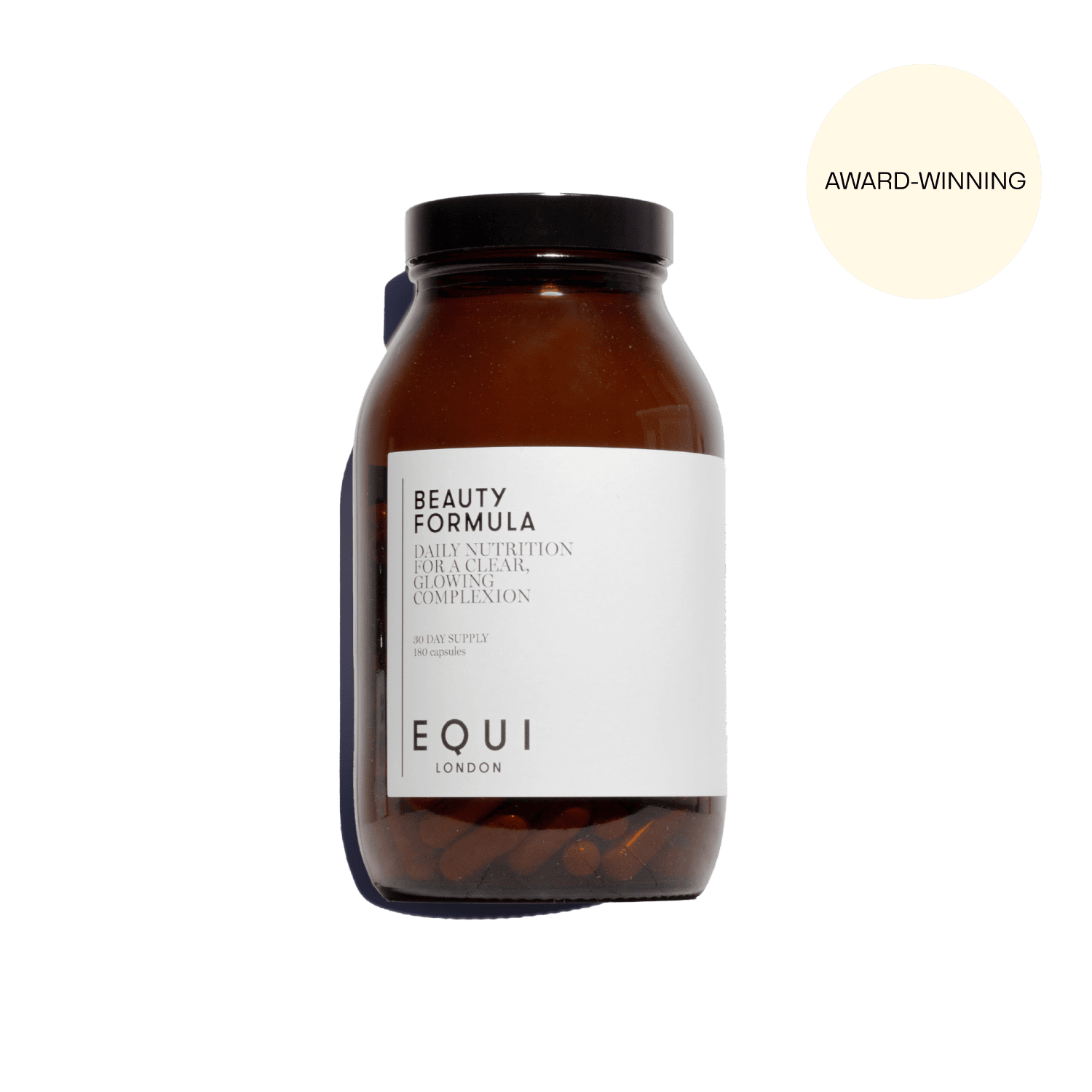
We spent a long time on the formulation before we launched. The question we kept asking was not what can we include, but what does a woman at this life stage actually need, and what is the evidence for each ingredient at the dose required to make a difference? The answer, in the case of Beauty Formula, was 48 nutrients. Not a multivitamin. Not a single-benefit supplement. A complete system covering gut, skin, hormones, energy, and immunity — working together the way the body actually works.
What does it actually cost to build your own supplement stack?
The maths are not complicated, but they are worth doing.
A high quality probiotic costs around £30 to £40 a month. Add a meaningful vitamin D, a good magnesium bisglycinate, zinc at a therapeutic dose, a skin-specific antioxidant blend, clinical-grade omega-3, and B vitamins in their active methylated forms — and you are looking at a conservative £155 to £185 a month for six nutrient categories. None of which includes the hormonal or gut-specific support Alice had built into my original protocol, or indeed the collagen which is the cherry on the cake, and not an inexpensive add on.
Beauty Formula is £59.50 a month on subscription, and it covers all of it and more.
For women in the UK looking for the best women's supplement they can take every day without a shelf full of bottles, the question is not which individual products to choose (and let's not get started on the compliance issues juggling all of these). It is whether one properly formulated product can do the job better.
The choice between eight separate supplements and one properly formulated product is not really about convenience — though consistency matters enormously, and a product you actually take every day is a product that works. It is about what happens to quality and dosing when you try to cut the cost of each individual product to make the pile more manageable.
The answer is not more products, but fewer, targeted products that do the job properly.
We didn't build Equi because we thought the supplement market needed another product. We built it because we had experienced firsthand what the right nutrition could do — and I couldn't accept that it should only be available to women lucky enough to have a clinical nutritionist as a best friend.
Rosie Speight, Co-Founder, Equi London
References
1. Abbasi F, Haghighat Lari MM, Khosravi GR, Mansouri E, Payandeh N, Milajerdi A. A systematic review and meta-analysis of clinical trials on the effects of glutamine supplementation on gut permeability in adults. Amino Acids. 2024 Oct 13;56(1):60. doi: 10.1007/s00726-024-03420-7. PMID: 39397201; PMCID: PMC11471693.
2. De Pessemier B, Grine L, Debaere M, Maes A, Paetzold B, Callewaert C. Gut-skin axis: current knowledge of the interrelationship between microbial dysbiosis and skin conditions. Microorganisms. 2021;9(2):353.
3. Ashkanani A, Ashkanani G, Yousef M, et al. Microbiome and skin health: a systematic review of nutraceutical interventions, disease severity, inflammation, and gut microbiota. Microorganisms. 2025;14(1):63.
4. Yee BE, Richards P, Sui JY, Marsch AF. Serum zinc levels and efficacy of zinc treatment in acne vulgaris: a systematic review and meta-analysis. Dermatol Ther. 2020;33(6):e14252.
5. Kazeminejad A, Hajheydari Z, Taghian SS, Gholizadeh N. Serum zinc, selenium, and vitamin D levels in patients with acne vulgaris: a case-control study. J Cosmet Dermatol. 2024;23(7):2455-2461.
Disclaimer: This article is for educational purposes only and does not constitute medical advice. Food supplements should not be used as a substitute for a varied, balanced diet or healthy lifestyle. Beauty Formula is not suitable during pregnancy or breastfeeding. If under medical supervision, consult a healthcare professional before use.


